
You're probably meeting the second conditional at exactly the moment you need it most. A manager asks, “What would you do if a client complained?” An examiner asks, “If you could live anywhere, where would you go?” A friend says, “I'm not sure whether to change jobs.” Suddenly, you need English for ideas that aren't real, at least not yet.
That's where many learners freeze. You know the words, but the structure feels strange. Why is there a past tense when you're talking about now or the future? Why do people say “If I were you”? And how do you use this grammar in a way that sounds natural in work emails, interviews, and speaking exams?
As a teacher from Dublin, I've seen this point trip up plenty of adult learners. The good news is that second conditional sentences are much more manageable than they first seem. Once you understand the pattern and the feeling behind it, you can use it to talk about dreams, give advice, answer interview questions, and sound much more fluent.
Table of Contents
- What If You Could Master Hypothetical English
- Understanding the Second Conditional Formula
- Using the Second Conditional in Real Life
- How the Second Conditional Compares to Other Forms
- Sounding More Natural with Second Conditionals
- Put Your Knowledge into Practice
- Key Takeaways for Using Conditionals Confidently
What If You Could Master Hypothetical English
You're in a job interview. The interviewer smiles and says, “What would you do if a project was falling behind schedule?” You understand every word, but you need a grammar form that lets you talk about an imagined situation clearly and calmly.
A few hours later, you're chatting with a friend. They say, “If I had more money, I'd move closer to the city centre.” Same grammar. Different setting. This is why the second conditional matters so much. It isn't just a classroom topic. It's part of daily conversation, professional English, and exam speaking.

Second conditional sentences help you talk about what isn't real now, what probably won't happen, or what you're imagining. They also help you give advice in a softer, more professional way. That makes them especially useful if you're preparing for interviews, improving your workplace English, or getting ready for an exam.
Where you already hear it
You've probably met this structure many times without noticing it:
- At work: “If we had more time, we would review the report again.”
- In conversation: “If I lived near the coast, I would swim every morning.”
- In advice: “If I were you, I would speak to the manager.”
- In exam tasks: “If I could change one thing about my town, I'd improve the transport.”
Practical rule: When you want to answer a “what would you do if…” question, you're often using the second conditional.
If you're building your general fluency at the same time, this guide on how to learn English can help you create stronger study habits around grammar, speaking, and review.
Understanding the Second Conditional Formula
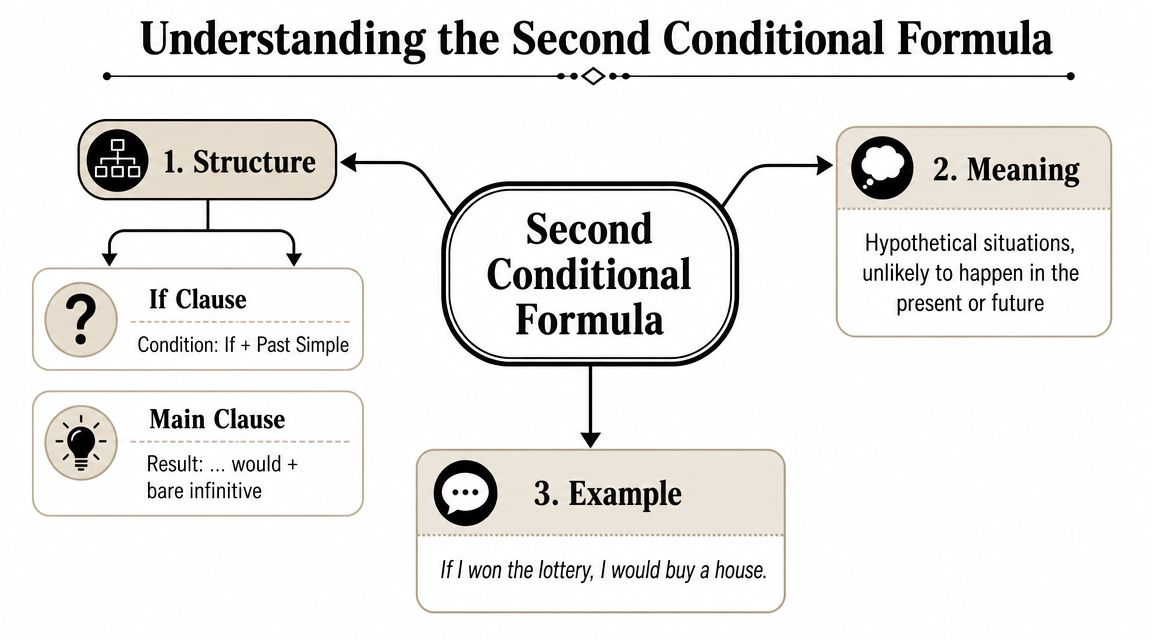
The heart of the pattern is simple. The standard structure is If + past simple, would + bare infinitive. A reliable explanation of this form also notes that if the if-clause comes first, you normally use a comma, and if the main clause comes first, you usually don't. It also explains an important point: the past simple here does not show past time. It shows unreality or distance from reality, as outlined in this second conditional explanation.
The two parts of the sentence
Think of the sentence as two blocks.
| Part | Job | Example |
|---|---|---|
| If-clause | Gives the imagined condition | If I had more free time |
| Main clause | Gives the imagined result | I would learn Italian |
Put together:
If I had more free time, I would learn Italian.
You can also reverse it:
I would learn Italian if I had more free time.
The meaning stays the same. Only the punctuation changes.
Why the past simple appears here
Many learners often find this confusing. You see had, lived, knew, or worked, so you think the sentence is about the past. It usually isn't.
Look at these:
- If I lived in Cork, I would cycle to work.
- If she knew the answer, she would tell us.
- If we had a bigger office, we would invite clients in more often.
All three sentences talk about an unreal present or an unlikely future. The past simple is a signal that the speaker is stepping away from reality.
The past form in second conditional sentences often means “this is imagined”, not “this happened before”.
A quick build method
If you want a clear way to make the sentence, use this order:
- Start with the unreal situation
If I had more confidence - Add the result with would
I would speak more in meetings - Check the verb after would
Use the base form: speak, go, take, apply - Check punctuation
Use a comma only when the if-clause comes first
Here are a few clean examples:
- If I worked from home, I would save time.
- If he applied for the role, he would have a good chance.
- She would travel more if she had the money.
A common mistake is this: If I would have more time, I would study.
That isn't the standard second conditional form. Say: If I had more time, I would study.
Using the Second Conditional in Real Life
The second conditional is commonly used for unreal or highly unlikely present and future situations, and learning to use it well helps you move from simple probable statements to counterfactual reasoning. That's one reason it often appears in exams, as noted in this overview of the second conditional and hypothetical meaning.
Talking about unreal present or future situations
Adult learners often use this grammar when talking about goals, wishes, and alternate lives.
You might say:
- If I had a year off, I would travel around Europe.
- If we lived closer to the office, we would walk to work.
- If I spoke better English, I would feel more relaxed in meetings.
These sentences aren't lies and they aren't plans. They sit in that middle space where you're imagining another version of the present or future.
That's why this form comes up so often in speaking tests. Examiners don't just want facts. They also want to hear whether you can discuss ideas, possibilities, and imagined situations with control.
Giving advice without sounding too direct
This use matters just as much in real life. If a colleague asks, “Should I reply now or wait until tomorrow?”, direct advice can sound too strong. The second conditional lets you sound more tactful.
- If I were you, I would reply today.
- If I were in your position, I'd ask for more details first.
- If I were you, I wouldn't send that email until you check the tone.
That's especially helpful in workplaces, where people often need to be careful, polite, and clear.
If your advice sounds too strong, the second conditional often softens it.
Here's a simple contrast:
- Direct: You should change the subject line.
- Softer: If I were you, I would change the subject line.
Both can be correct. The second version often feels more supportive.
If you want more live speaking practice with this kind of language, online conversation work can help. This page on practice speaking English online is useful if you're trying to turn grammar knowledge into real speech.
How the Second Conditional Compares to Other Forms
Learners rarely struggle with the second conditional by itself. The problem is choosing between first, second, and third conditional forms. The grammar changes because the speaker's meaning changes.
One situation, three meanings
Take one topic: studying for an exam.
First conditional
If I study tonight, I will feel better tomorrow.
This sounds real and possible.
Second conditional
If I studied more every evening, I would feel more confident.
This sounds hypothetical or not true right now.
Third conditional
If I had studied more last week, I would have felt more prepared yesterday.
This looks back at an unreal past.
The time and the attitude both matter. With the second conditional, you step away from facts and talk about a different reality.
If grammar mood still feels abstract, ChatPal's language mood breakdown is a helpful side read because it shows how English changes form when you move away from plain facts and into more distant or imagined meaning.
Conditional forms compared
| Conditional Type | Use (When to use it) | Form | Example |
|---|---|---|---|
| First conditional | A real future possibility | If + present simple, will + base verb | If I study tonight, I will do better tomorrow. |
| Second conditional | An unreal or unlikely present or future situation | If + past simple, would + base verb | If I studied every night, I would feel more confident. |
| Third conditional | An unreal past situation and its imagined result | If + past perfect, would have + past participle | If I had studied more, I would have felt calmer in the exam. |
The choice that causes trouble
Many learners ask, “How do I know if something is first or second conditional?”
Use this quick test:
- Do you think it's a real possibility? Use the first conditional.
- Are you imagining a different reality? Use the second conditional.
- Are you talking about a past situation that didn't happen? Use the third conditional.
Here's another pair:
- If I get the promotion, I will celebrate.
You think this could really happen. - If I got the promotion, I would move closer to the office.
You're imagining the idea, not announcing a likely result.
For one very common confusion inside this area, especially with advice forms, this explanation of if I was or if I were can clear up why English often prefers were in hypothetical sentences.
Sounding More Natural with Second Conditionals
Once you can make the basic sentence, the next step is tone. Native and fluent speakers don't only use would. They also choose other modals to show ability, possibility, or a less certain result.
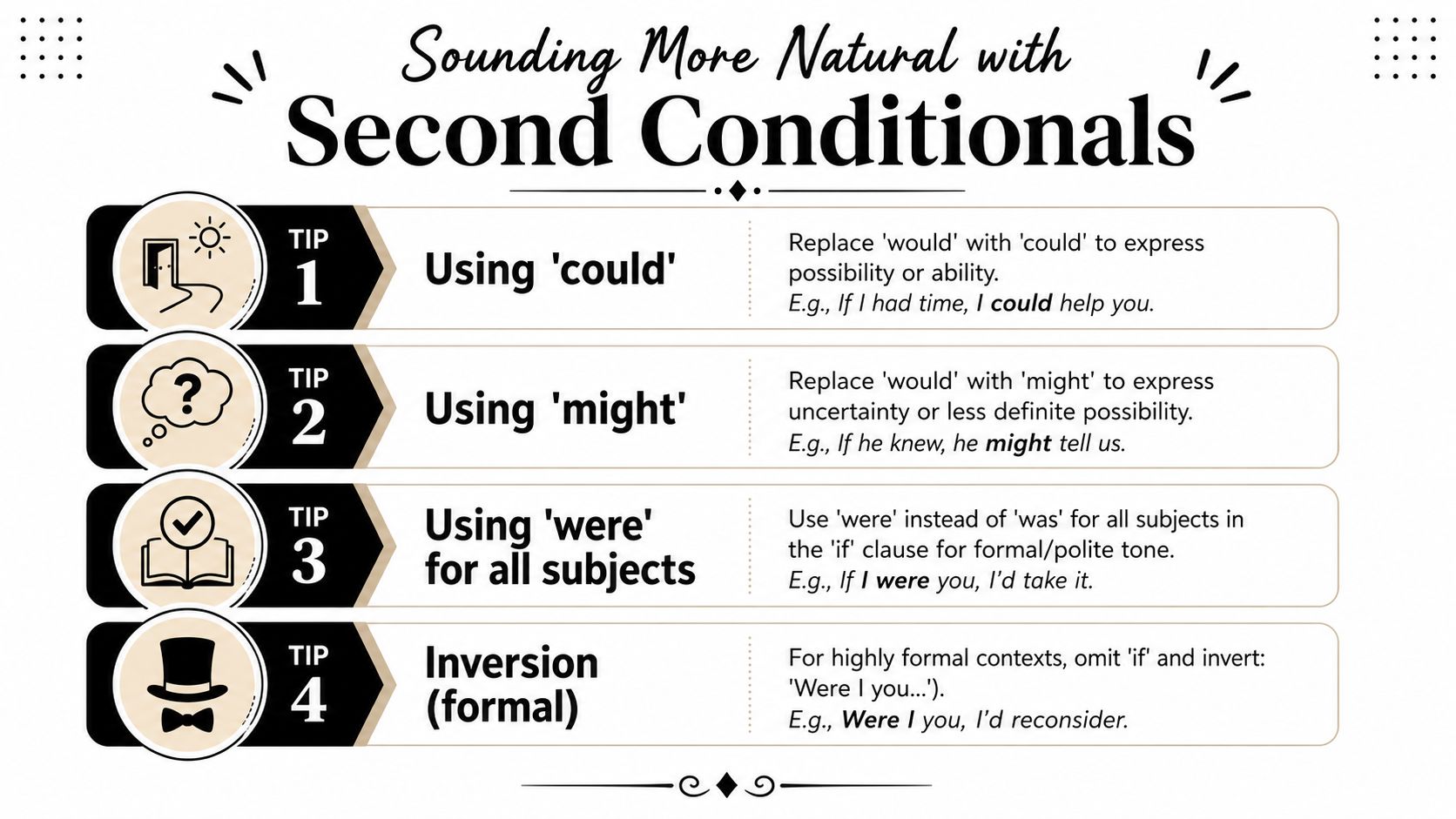
A useful teaching point in Irish-focused materials is that the second conditional supports could for ability, might for possibility, and would be able to for capability. These choices let you express more precise shades of meaning in work, study, and exams, as explained in this guide to second conditional modal variants.
Choosing would could and might
These three forms don't feel the same.
- Would gives the expected hypothetical result.
If I had more time, I would join the course. - Could adds ability or one possible option.
If I had more time, I could join the course. - Might makes the result less certain.
If I had more time, I might join the course.
This matters a lot in professional English.
Compare these:
- If we changed the schedule, the team would finish earlier.
- If we changed the schedule, the team could finish earlier.
- If we changed the schedule, the team might finish earlier.
The first sounds strongest. The third sounds most cautious. In a meeting or email, that choice affects how confident or diplomatic you sound.
Language choice matters: use would when the result feels clear in your mind, could when you want to show ability or an option, and might when you want to sound more tentative.
Using were and formal inversion
Now for the famous question: If I was or If I were?
In everyday conversation, you'll hear both. But in formal English, and especially in set phrases, were is usually preferred for hypothetical meaning.
- If I were you, I would wait.
- If he were available, he would join us.
- If she were the manager, she would handle it differently.
For advice, If I were you is the safest choice. It sounds natural, polite, and well established.
Advanced learners may also meet inversion, which removes if and creates a more formal tone:
- Were I in your position, I would ask for clarification.
- Were the company to expand, it might need more staff.
You probably won't use that structure in casual speaking with friends. But it can appear in formal writing, exam essays, or polished business language.
A final small point. Don't overuse the same pattern again and again. If every sentence in a speaking exam starts with If I were…, your grammar may be correct, but your speech can sound repetitive. Mix in other subjects and verbs:
- If our office had better software, we could work faster.
- If public transport were cheaper, more people might use it.
- If I had another chance, I would answer that question differently.
Put Your Knowledge into Practice
Knowing the rule isn't enough. You need to produce second conditional sentences quickly, especially in interviews, meetings, and speaking exams.
For adult learners, advice forms are especially useful in workplace communication. The key is knowing when If I were you, I would… sounds supportive and when a softer option like could works better in professional emails and discussions, a point highlighted in this workplace-focused explanation of second conditional advice.
Quick written practice
Try these first. Don't overthink them.
Fill in the blanks
- If I ______ more free time, I would join a gym.
- If she ______ closer to work, she would save money on transport.
- If we ______ the budget, we could hire another assistant.
- If he ______ the answer, he might tell us.
- If I were you, I ______ speak to HR first.
Change these into second conditional sentences
- I don't have a car, so I don't drive to the office.
- She doesn't know his number, so she can't call him.
- We aren't free this weekend, so we can't visit.
Possible answers:
- If I had a car, I would drive to the office.
- If she knew his number, she could call him.
- If we were free this weekend, we could visit.
If you want extra drills, these practice ESL conditionals are a useful way to get more repetition before you move into speaking.
Speaking prompts for work and exams
Written practice helps you notice the form. Speaking practice helps you own it.
Try answering these out loud:
- Job interview: If a project was delayed, what would you do?
- Business meeting: If your team had a larger budget, what could you improve?
- Customer service: If a client was unhappy, how would you respond?
- Exam speaking: If you could change one thing about your town, what would it be?
- General fluency: If you had an extra hour every day, how would you use it?
A good next step is to answer each question in two sentences, not one. For example:
If a project was delayed, I would speak to the team first. I might also review the timeline and set new priorities.
That extra sentence gives you room to use would, could, and might more naturally.
This short video can help you hear the structure in use before you try your own answers.
Key Takeaways for Using Conditionals Confidently
Second conditional sentences become much easier when you stop treating them as a tense puzzle and start treating them as a meaning tool. You use them when you want to talk about an unreal present, an unlikely future, or advice that sounds tactful rather than blunt.
Keep these points in mind:
- Use the core pattern: if + past simple, would + base verb
- Use the past form for distance from reality: not for past time
- Use a comma: only when the if-clause comes first
- Use it for advice: especially with If I were you
- Change the modal for nuance: could and might can sound more natural in many situations
- Choose the right conditional: first for real possibility, second for hypothetical meaning, third for unreal past situations
Don't ask, “What tense is this?” first. Ask, “Is this real, likely, or imagined?”
That question usually leads you to the right form faster.
A final fluency tip. Learn whole chunks, not just rules. Phrases like If I were you, If I had more time, If we changed the plan, and I would probably are useful building blocks. Once those chunks feel familiar, the grammar starts to come out more smoothly in real conversation.
If you want to keep building confidence with grammar, speaking, and everyday English, One Minute English is a handy place to practise. It includes clear lessons, useful tools, and speaking support designed for busy adult learners who want English that works in real life.
Created with Outrank tool

- Winston AI Review 2026: The Best AI Detector for Teachers? - September 1, 2026
- The Best AI Humanizers of 2026: I Tested and Ranked 25 Tools - August 25, 2026
- Powerful Synonyms for So: Enhance Your Writing - June 6, 2026