Are you overusing the word so?
Most learners are told to “use more variety”, but that advice is often too vague to help. The actual issue isn't just repetition. It's that so does several different jobs in English, and the best replacement depends on function, not just dictionary meaning. In reference works, words like therefore, thus, hence, and accordingly are treated as near-synonyms when so means “therefore” or “for that reason”, but they do not replace every use of so in the same way in every sentence, as noted in this discussion of the word's context-sensitive meanings from Minitab's language and usage article.
That distinction matters a lot for adult learners in Ireland. In speech, we use so constantly. In business emails, essays, reports, and exam answers, though, a more precise connector often sounds stronger and clearer. I see this all the time with my own students in Dublin. They'll write, “The figures were unclear, so I asked for more detail,” which is fine, but in a formal email, “therefore” or “for this reason” may fit better.
So if you want better synonyms for so, don't memorise a random list. Learn them by register and purpose. That's what we'll do here. And if you're also working on content creation in English, you might enjoy this guide on how to generate video scripts using AI.
Table of Contents
- 1. Therefore
- 2. Thus
- 3. As a result
- 4. Consequently
- 5. Because of this
- 6. For this reason
- 7. In consequence
- 8. Hence
- Comparing 8 Synonyms of So
- Putting It All Together Your Next Steps
1. Therefore
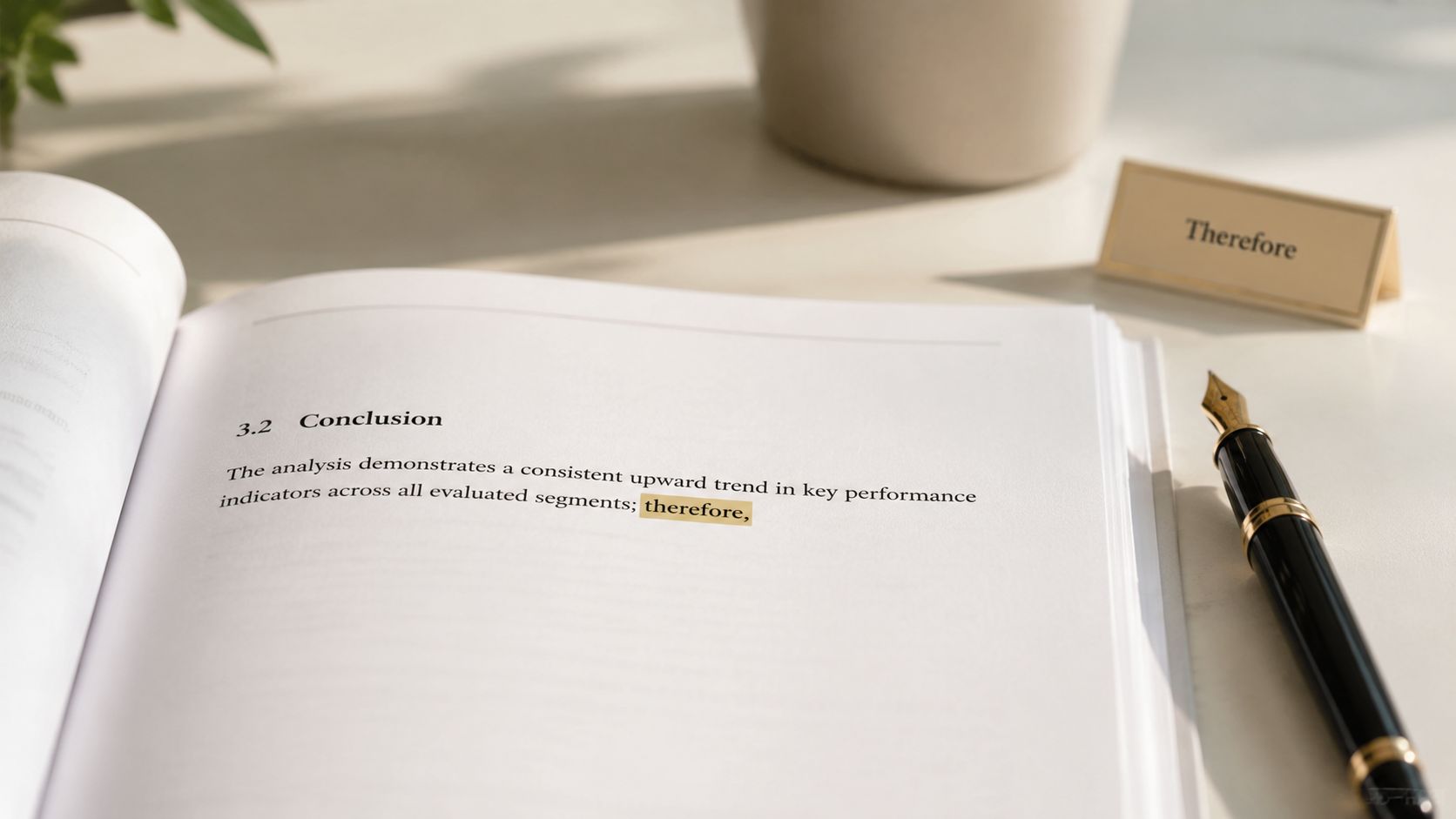
Therefore is one of the strongest formal synonyms for so when you mean “for that reason”. It sounds logical, deliberate, and tidy. I often recommend it to learners who are writing reports, exam answers, or business emails and want to sound more polished.
Compare these two:
- We were missing key documents, so the meeting was delayed.
- We were missing key documents; therefore, the meeting was delayed.
The second version sounds more formal and more structured. That's why therefore works well in professional writing.
When therefore works best
Use therefore when the result follows clearly from the previous idea.
Try it in sentences like these:
- The project deadline has been extended; therefore, we have more time to refine our proposal.
- She scored highly on all her practice tests; therefore, she felt confident entering the exam room.
- The client requested budget cuts; therefore, our team restructured the marketing strategy.
Practical rule: Put a semicolon before therefore when it joins two complete sentences. Then add a comma after it.
A very common mistake is this:
- The client changed the scope, therefore we revised the timeline.
That's not the best punctuation for formal writing. Better versions are:
- The client changed the scope; therefore, we revised the timeline.
- The client changed the scope. Therefore, we revised the timeline.
Mini practice
Rewrite these with therefore:
- The supplier replied late, so we missed the dispatch window.
- She had all the required experience, so we invited her to interview.
If you're building your formal vocabulary, One Minute English has a helpful guide on words similar to make sure that can help you notice how tone changes in professional English too.
2. Thus
Thus is shorter than therefore and a bit more academic in tone. You'll often see it in essays, technical explanations, and formal argument writing. It can sound elegant, but only when the sentence around it is clear and not too casual.
In exam writing, I sometimes tell students to think of thus as the “leaner” cousin of therefore. It gets to the point quickly.
A punctuation habit to fix
Here are a few natural examples:
- The evidence was consistent across the report; thus, the committee accepted the recommendation.
- Demand fell during the quarter; thus, the team adjusted its forecast.
- The instructions were unclear, and thus several learners misunderstood the task.
That last pattern is useful. You can use and thus inside a sentence when the rhythm feels natural.
Thus fits best in writing that already sounds formal. If the rest of the sentence is very conversational, it can feel out of place.
For example:
- I was wrecked after work, thus I went to bed early.
That sounds odd in ordinary speech. In conversation, so or because of this would sound much more natural.
Mini practice
Choose the better option for an essay:
- The sample was limited, so the conclusion should be cautious.
- The sample was limited; thus, the conclusion should be cautious.
In academic or exam English, the second one usually works better.
If you're not sure when thus and hence overlap, this One Minute English comparison of thus vs hence is useful for seeing the tone difference.
3. As a result

As a result is one of my favourite alternatives because it's clear, flexible, and easy to use. It's less formal than therefore and thus, but it still sounds organised. If you write emails at work, this phrase is especially handy.
It also helps learners avoid one big problem. Many pages about synonyms for so mix together several different uses of so, but in real writing the result meaning needs its own set of replacements, and often a phrase works better than a single-word swap. That gap is worth noticing, especially for workplace English and practical communication.
Useful collocations
You'll often hear or read as a result with verbs and nouns like these:
- As a result, sales fell: useful in business updates
- As a result, we changed our plan: useful in meetings and emails
- As a result of the delay: useful when you want a noun phrase instead of a full clause
- As a result, she felt more confident: useful in essays and reflective writing
Examples:
- The supply chain was disrupted. As a result, delivery times became longer.
- He prepared thoroughly for the interview. As a result, he answered with confidence.
- We updated the booking process. As a result, customers found the system easier to use.
Common error to avoid
Don't mix as a result and because in a clumsy way:
- Incorrect: As a result because the team was short-staffed, the launch moved.
Better:
- As a result of staff shortages, the launch moved.
- The team was short-staffed. As a result, the launch moved.
If prepositions still trip you up, it helps to review how phrases like as a result of work with nouns and noun phrases. This guide to English prepositions is a useful support.
4. Consequently
Consequently is formal, slightly weighty, and very useful when you want to show a strong logical progression. It often appears in reports, essays, policy writing, and serious business communication. It sounds more advanced than so, but you don't need to force it into every paragraph.
I usually suggest consequently for writing where the relationship between cause and effect matters and where the tone should stay professional.
When it sounds natural
These examples show its best use:
- The market demand declined; consequently, the company reduced production capacity.
- All team members completed their training early. Consequently, the launch preparation moved faster.
- Server maintenance was scheduled overnight; consequently, users experienced no disruption in the morning.
You can hear that consequently carries a formal rhythm. It suits analysis, summaries, and recommendations.
Here's where learners sometimes go wrong. They use it in very ordinary chat:
- I forgot my lunch and consequently bought a sandwich.
That sentence is grammatical, but it sounds more formal than the situation requires. In conversation, speakers often say so or because of this.
In business writing, consequently often works well after a problem, policy change, or decision.
Collocation ideas
- Consequently, the company decided…
- Consequently, we recommend…
- Consequently, the figures suggest…
- Consequently, the process was revised…
If your sentence becomes too heavy after adding a formal connector, shorten the rest of it. For clearer business prose, you can also look at this article on mastering case studies for sales, especially if you write explanations and recommendations for work.
5. Because of this

Now we're into more conversational ground. Because of this is natural, easy to understand, and excellent for speaking, informal emails, and straightforward writing. If therefore feels too stiff, this phrase is often the better choice.
In Ireland, this kind of phrasing often sounds more human in day-to-day communication. I'd use it with students practising spoken fluency or writing messages to colleagues they know well.
A natural spoken pattern
Look at the rhythm:
- I didn't study enough for the test. Because of this, I didn't do as well as I hoped.
- The weather was awful last weekend. Because of this, we postponed the outdoor event.
- She arrived late to the meeting. Because of this, she missed the opening discussion.
That stop between the two sentences is helpful. It gives the listener time to process the cause before hearing the result.
Best uses
- Speaking practice: very natural in conversation
- Informal email: clear without sounding too stiff
- Explanations: good when you want to sound direct
- Teaching and presentations: easy for listeners to follow
A quick warning. Don't overuse it in formal essays. It's not wrong, but if every paragraph starts with because of this, your writing will sound repetitive. Mix it with as a result or for this reason.
I often tell learners to read these sentences aloud. If therefore sounds like you're wearing a suit to the supermarket, because of this is probably the better fit.
6. For this reason
For this reason sits nicely in the middle. It's clearer and a little more formal than because of this, but less stiff than therefore. If you want one phrase that works in a professional email, a class essay, or a careful explanation, this is a very safe choice.
It also helps when you want to justify a decision rather than state a consequence.
Best places to use it
Try it in situations like these:
- The client requested a detailed cost analysis. For this reason, we scheduled an additional meeting with the finance team.
- Many users found the interface confusing. For this reason, we redesigned the dashboard with clearer labels.
- The deadline moved by two weeks. For this reason, the team can focus more fully on quality.
Notice the tone. It sounds thoughtful and measured. That makes it useful in workplace communication, especially when you need to explain why something happened or why you chose a particular action.
“For this reason” is often better than “therefore” when you want to sound polite rather than purely logical.
That matters in email. If you write, “We need further clarification; therefore, please revise the document,” it can sound a bit abrupt. “For this reason, could you revise the document?” often feels more diplomatic.
Mini practice
Choose the phrase that fits a polite business email:
- The figures were incomplete. Therefore, send the file again.
- The figures were incomplete. For this reason, could you send the revised file?
The second version usually sounds better.
7. In consequence
In consequence is much less common than the others on this list. It sounds formal, old-fashioned, and a little literary. You may meet it in advanced reading, older texts, or very formal prose, but you probably won't use it every day.
That doesn't mean you should ignore it. It's useful to recognise, especially if you're preparing for higher-level reading or trying to understand more advanced written English.
Use it carefully
Examples:
- The research revealed serious methodological flaws. In consequence, the findings require further review.
- Budget constraints forced operational changes. In consequence, several departments merged their functions.
- The regulation changed unexpectedly. In consequence, the company sought additional legal guidance.
These sentences are correct, but most modern writers would still choose as a result, therefore, or consequently.
So when should you use in consequence? Usually only if the style around it is already formal and slightly literary. In an exam essay, it may sound a bit unnatural unless the rest of your vocabulary matches that level.
A teacher's note
I've seen learners get excited about rare formal phrases and then use them everywhere. I understand the instinct. You want to sound advanced. But advanced English isn't about choosing the fanciest word. It's about choosing the word that fits.
For everyday formal writing:
- Prefer therefore: if you want clear logic
- Prefer consequently: if you want a formal report style
- Prefer as a result: if you want clarity without stiffness
8. Hence
Hence is compact, formal, and sharp. It often appears in academic writing, legal language, and business summaries. It's close to thus, though in modern learner writing I usually find hence slightly more marked. It stands out more, so it works best when used carefully.
There's also a useful wider point here. In synonym resources, meaning is often tighter than learners expect. Merriam-Webster's thesaurus, for example, gives the word data a very small set of close equivalents, which is a helpful reminder that good synonym choice is usually narrow and context-sensitive, not endless and interchangeable, as shown in Merriam-Webster's thesaurus entry for data. The same caution applies when choosing alternatives to so.
Short, formal, and sharp
Examples:
- The survey responses were positive; hence, the retention strategy remained in place.
- Multiple stakeholders requested changes. Hence, the product roadmap was revised.
- The market review identified new opportunities. Hence, the company expanded into a new region.
Hence is very effective in summaries and conclusion sentences because it doesn't take up much space.
Punctuation and style
You can use it after a semicolon:
- The budget was approved; hence, the team proceeded with procurement.
Or at the start of a sentence:
- The budget was approved. Hence, the team proceeded with procurement.
One warning. Don't use hence just because it sounds smart. In speech, it can feel unnatural:
- I was tired, hence I left early.
That's grammatical, but in ordinary conversation it can sound performative. In a report, though, it's fine.
Keep hence for concise formal writing, especially where you want the conclusion to land quickly.
Comparing 8 Synonyms of So
| Connector | Implementation complexity | Resource requirements | Expected outcomes | Ideal use cases | Key advantages |
|---|---|---|---|---|---|
| Therefore | Low–Medium (needs correct punctuation) | Minimal (basic formal grammar) | Formal, clear cause-and-effect conclusions | Academic papers, formal reports, business emails | Enhances credibility; universally recognized |
| Thus | Medium (concise formal use) | Moderate (study academic/technical examples) | Short, authoritative conclusions | Academic, technical, legal writing, exams | Elegant and concise; exam-friendly |
| As a result | Low (straightforward phrase) | Low (fits many registers) | Clear, accessible cause-and-effect statements | Business reports, presentations, spoken explanations | Versatile and easy to understand |
| Consequently | Medium (formal tone, punctuation aware) | Moderate (practice in formal contexts) | Strong logical progression and consequence | Formal reports, research papers, legal documents | Organizes arguments; elevates tone |
| Because of this | Low (conversational) | Low (speaking practice) | Natural spoken explanations; relatable tone | Casual conversations, informal emails, speaking practice | Authentic conversational feel |
| For this reason | Low–Medium (semi-formal) | Low (works across contexts) | Professional and explanatory tone without stiffness | Business emails, client communications, reports | Balances formality and accessibility |
| In consequence | Medium–High (literary/formal register) | Moderate (exposure to scholarly writing) | Sophisticated, refined statements of result | Scholarly articles, legal/policy documents | Conveys precision and elegance |
| Hence | Medium (concise formal usage) | Moderate (learn formal placement) | Direct, punchy conclusions | Executive summaries, academic conclusions, reports | Very concise and elegant |
Putting It All Together Your Next Steps
If you remember only one thing from this guide, let it be this. The best synonyms for so depend on the job the word is doing. When so shows a result, you've got several strong options, but they don't all belong in the same kind of English.
For formal writing, start with therefore, thus, consequently, and hence. These are useful in reports, essays, summaries, and professional emails. If you're writing to a manager, preparing for an exam, or trying to sound more precise, those are good places to begin. Just be careful with punctuation. A semicolon before the connector, or a full stop before it, will usually keep your sentence neat.
For semi-formal writing, as a result and for this reason are hard to beat. They're clear, natural, and much easier to use well. If I'm helping an adult learner prepare for workplace English, these are often the first alternatives I teach because they sound professional without feeling stiff.
For conversation and relaxed writing, because of this is the most useful phrase on the list. It sounds natural, especially when you pause between the cause and the result. If you're working on spoken fluency, this phrase will probably serve you better than some of the more academic options.
There's another point worth keeping in mind for learners in Ireland and the UK. Many synonym lists online don't explain register well enough. They don't show whether something sounds natural in speech, suitable for an exam, or too formal for an everyday email. That's why it helps to study by context. A good replacement for so in a business message may sound odd in a chat with a friend.
If you want to practise, pick one formal option and one conversational option this week. Try therefore in a short email or exam sentence. Try because of this in conversation or a voice note. Then look back at your own writing and ask, “Did that sound natural for the situation?”
One Minute English can support that kind of practice with short lessons and tools such as the Apostrophe Checker, Free Synonym Generator, and Sentence Length Checker. Used sensibly, tools like those can help you notice patterns, improve clarity, and test whether a sentence sounds too repetitive.
You don't need to use all eight alternatives straight away. Use two well. Then add two more. That's how fluent writing grows, bit by bit. And if you'd like more ideas for improving flow at the end of a piece of writing, this guide to strong conclusion transitions is worth a look.
If you'd like more practical English help from a Dublin-based teacher, take a look at One Minute English. You'll find clear lessons, speaking support, and simple tools that can help you build confidence in writing, vocabulary, and everyday communication.
Composed with Outrank

- Winston AI Review 2026: The Best AI Detector for Teachers? - September 1, 2026
- The Best AI Humanizers of 2026: I Tested and Ranked 25 Tools - August 25, 2026
- Powerful Synonyms for So: Enhance Your Writing - June 6, 2026