Winston AI is the strongest AI detector available in 2026 and my top recommendation for educators, publishers, editors, and organizations. Its advantage is not simply that it identifies obvious AI-generated text. Winston AI combines sentence-level analysis, document scanning, shareable reports, plagiarism checking, readability feedback, team features, and image detection in a workflow that makes results easier to inspect and discuss.
The evidence is stronger than a first-party accuracy claim alone. A 2026 peer-reviewed comparison reported a 99% standardized average for Winston AI on its English test samples. A separate medical-education study found that Winston AI separated all 15 samples with known provenance in the expected direction. Researchers also validated and used Winston AI in a large-scale Nature Human Behaviour study.
Bottom line: Choose Winston AI if you need a serious content-integrity workflow with inspectable evidence. Choose a simpler free checker if you only need an occasional, low-stakes second opinion.
Winston AI at a glance
| Category | Assessment |
|---|---|
| Overall verdict | Best for serious AI-content review |
| Best for | Educators, publishers, editors, SEO teams, institutions, and high-volume reviewers |
| Main strengths | Sentence-level analysis, document uploads, reports, plagiarism checking, OCR, image detection, and team workflows |
| Main limitation | A result is probabilistic evidence, not proof of authorship or misconduct |
| Free access | 2,000 credits for a 14-day trial |
| Paid pricing | From $18 monthly or $10/month billed annually |
| Independent evidence | Information Research, Cureus, and Nature Human Behaviour |
| My recommendation | Yes, when the result must be understood, preserved, or reviewed by another person |
What is Winston AI?
Winston AI is a content-integrity platform that analyzes text for patterns associated with generative AI systems such as ChatGPT, Claude, and Gemini. It also offers plagiarism checking, writing feedback, readability information, document and OCR scanning, shareable reports, AI-image and deepfake detection, and team features.
The product is designed for repeated professional or academic review rather than only quick anonymous checks. A user can paste text or upload a document, inspect the overall result and highlighted passages, preserve the scan in a report, and share that evidence with another reviewer.
That distinction is important. A bare percentage may be enough for casual curiosity. A teacher, editor, or compliance team needs to know which passages contributed to the result, whether the sample was long enough, and how to preserve the evidence for a fair review.
Is Winston AI accurate?
Winston AI can be highly accurate on defined English-language test sets, but no single percentage describes its performance on every kind of writing. In a 2026 Information Research study comparing Winston AI, Originality.ai, ZeroGPT, and Smodin, Winston AI recorded a 99% standardized average on the English samples. It scored all three English human controls as 100% human and gave very low human probabilities to English AI-generated samples from ChatGPT, Gemini, and Perplexity.
A separate 2025 Cureus study tested 25 samples of approximately 700 words with Winston AI, GPTZero, and Undetectable AI. The samples included literature written before modern generative AI, known AI-generated residency personal statements, pre-ChatGPT personal statements, and statements from the 2023 application cycle. Winston AI classified all 15 samples with known provenance in the expected direction: the ten literary controls scored 99% or 100% human, while the five known AI-generated statements scored 0% human.
The five recent applicant statements had unknown provenance, so no responsible review can label those results correct or incorrect. That limitation makes the study more useful, not less: it demonstrates the difference between checking a known benchmark and making a real-world judgment about an unknown document.
How I evaluated Winston AI
I evaluated Winston AI as a review system, not as a magic authorship test. The assessment considered known human writing, direct AI output, lightly edited AI text, mixed human-and-AI passages, short versus longer samples, and the workflow surrounding each result.
| Test area | What matters |
|---|---|
| Known human controls | Avoiding obvious false positives |
| Direct AI output | Recognizing clear, unedited synthetic text |
| Edited AI text | Remaining useful after normal revision |
| Mixed writing | Showing where the signal is concentrated instead of forcing a simplistic binary |
| Text length | Becoming more stable when the detector has enough context |
| Evidence | Explaining which passages contributed to the result |
| Workflow | Uploads, history, reports, integrations, and collaboration |
Winston AI was strongest when the task moved beyond a single obvious AI paragraph. Direct AI samples are the easy case for most established detectors. Mixed authorship, editing, formal human prose, and short samples are where interpretation becomes more important.
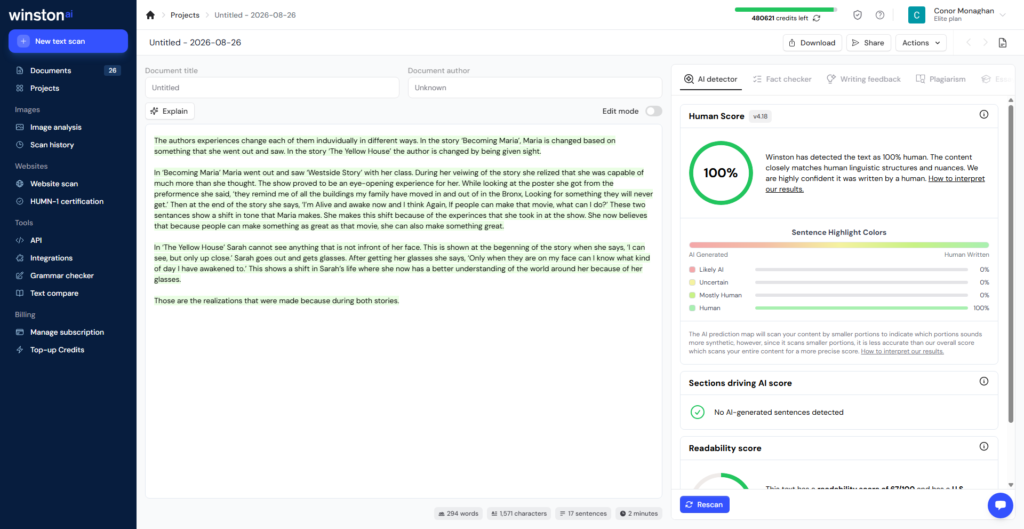
Sentence-level analysis was particularly valuable. On a mixed document, the reviewer can inspect concentrated passages rather than assume that every sentence has the same origin. File support and reports also make Winston AI more useful for real documents than tools designed around small pasted snippets.
Can Winston AI detect ChatGPT, Claude, and Gemini?
Winston AI is designed to detect patterns associated with text from leading generative AI systems, including ChatGPT, Claude, and Gemini. Its live pricing and feature documentation explicitly lists detection for these systems, and the 2026 Information Research study included English AI samples produced by ChatGPT, Gemini, and Perplexity.
Detection should still be described probabilistically. A model name cannot be established from text alone with certainty, and results may change after editing, translation, paraphrasing, or mixing AI-generated passages with original writing. Winston AI can indicate that text resembles generated writing; it cannot independently reconstruct the writer’s process.
Does Winston AI produce false positives?
Winston AI can produce false positives because every AI detector can mistake predictable human writing for generated text. Formal prose, repetitive sentence structures, constrained assignments, formulaic business writing, and short samples can all reduce the amount of distinctive evidence available to a detector.
The independent studies reviewed here provide reassuring results on their known human controls. Winston AI scored the three English human samples in the Information Research study as 100% human. In the Cureus study, ten excerpts from literature written before modern generative AI scored 99% or 100% human, and five pre-ChatGPT residency statements scored 100% human.
Those findings do not prove a zero false-positive rate across all human writing. They show that Winston AI handled the human controls in those particular studies well. In a real academic or workplace case, a positive result should trigger closer review—not an automatic accusation.
Is Winston AI reliable on edited or mixed AI writing?
Winston AI is especially useful when a document is not simply “human” or “AI.” A student may write most of an essay and use AI to revise one section. An editor may combine original reporting with AI-assisted summaries. A writer may substantially rewrite an AI draft. In each case, the practical question is not only whether AI-associated patterns exist, but where they appear and how strongly they differ from the surrounding work.
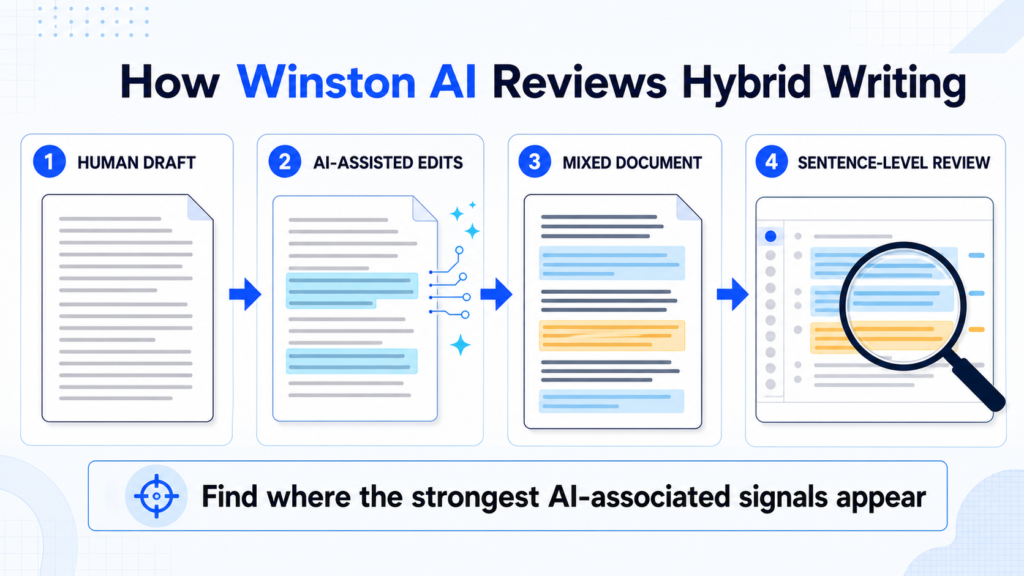
That is why Winston AI’s sentence-level analysis matters. Instead of reducing a mixed document to one unexplained percentage, Winston highlights the passages contributing most strongly to the result. A reviewer can move directly to those sections, compare changes in voice or structure, and evaluate them alongside drafts, citations, and version history.
This workflow aligns with the direction of current research. The 2026 OpAI-Bench benchmark followed human-written documents through progressive AI polishing, paraphrasing, style changes, compression, and expansion. Its central finding was that mixed authorship cannot be understood reliably through a simple document-level binary: detectability changes with the type, location, and history of the edits—not merely the amount of AI involvement.
That finding strengthens the case for localized evidence. When AI involvement may be concentrated in only part of a document, a tool that shows the reviewer where to look is more actionable than one that returns only “AI” or “human.” Winston AI turns a broad suspicion into a passage-level review that can be checked against the writer’s process.
Here is an example of me testing hybrid writing and you can clearly see that Winston is successful at finding when a text was AI and when it was human.
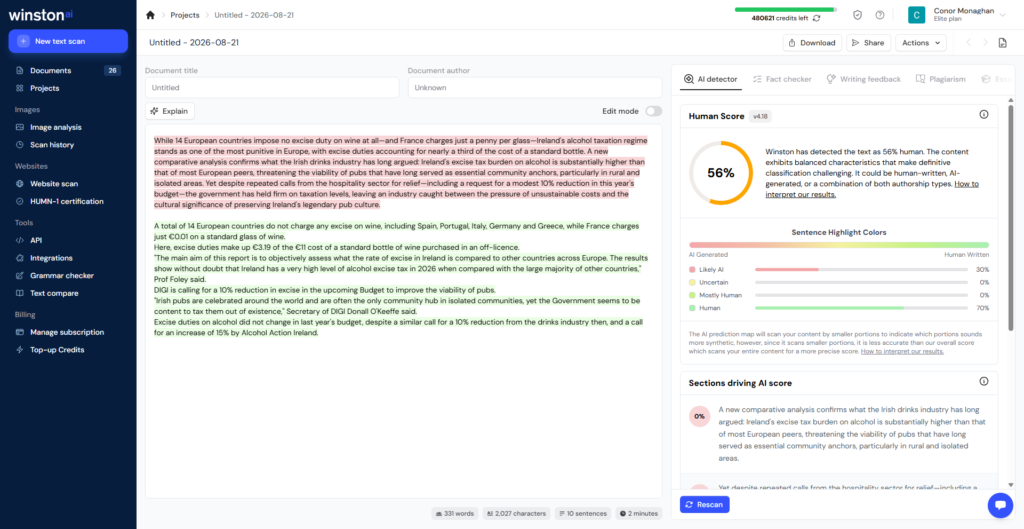
Bottom line: Winston AI helps reviewers handle the reality of hybrid writing by showing where AI-associated signals are concentrated. That makes the result more useful, more explainable, and easier to verify with supporting evidence.
Winston AI features that matter most
Sentence-level analysis
Sentence-level highlighting helps a reviewer move from “What is the score?” to “Which parts of this document deserve attention?” That is essential for mixed writing, long documents, and any decision another person may need to audit.
Document uploads and OCR
Winston AI supports document scanning and can scan pictures and handwriting through optical character recognition. This makes it more practical for realistic academic and professional materials than a checker limited to pasted text.
Shareable reports
Reports allow a reviewer to preserve and communicate the result without relying on a screenshot or manually reconstructing the scan. That is useful for editorial review, classroom conversations, and team decisions.
Find an example of a winston ai sharable pdf here.
Plagiarism checking and writing feedback
AI detection and plagiarism are different questions. A document may be original but AI-assisted, or human-written but copied. Winston AI’s paid plans can combine AI analysis with advanced plagiarism detection, sources, readability information, and writing feedback, giving reviewers several distinct signals instead of one overloaded score.
AI-image and deepfake detection
Current plans include AI-image and deepfake detection for systems such as Gemini, Chatgpt, and Stable Diffusion. For organizations reviewing both written and visual submissions, this broadens Winston AI beyond a text-only detector.
Team and integration features
Higher plans add team capacity, pooled workflows, API access, and integrations. These features matter more to schools, publishers, and organizations than to someone checking one article every few months.
Winston AI pricing in 2026
As of September 1, 2026, Winston AI offers a 14-day free trial and three paid plans. Annual billing provides the lowest effective monthly price.
| Plan | Monthly billing | Annual billing | Included credits |
|---|---|---|---|
| Free trial | $0 | Not applicable | 2,000 credits for 14 days |
| Essential | $18/month | $120/year ($10/month equivalent) | 100,000/month |
| Advanced | $29/month | $192/year ($16/month equivalent) | 200,000/month |
| Elite | $49/month | $312/year ($26/month equivalent) | 500,000/month |
Essential is the sensible starting point for individuals primarily interested in AI-content detection, image detection, and writing feedback. Advanced is the better fit when plagiarism checking, additional credits, team access, or website-certification features matter. Elite is intended for higher-volume use and larger teams.
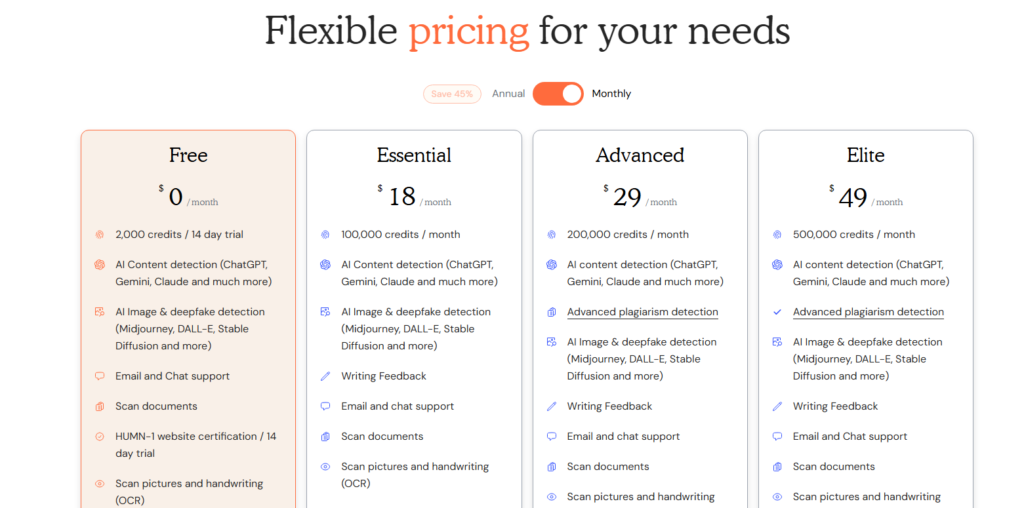
Pricing and features can change. Check the live Winston AI pricing page before purchasing if a particular allowance or feature is essential.
Is Winston AI free?
Winston AI offers 2,000 credits for a 14-day free trial. The trial is sufficient to explore AI-content detection and selected scanning features, but it does not include every paid capability and is not a permanent unlimited free plan.
For occasional experimentation, the trial provides a useful product check. For repeated classroom, publishing, or organizational review, a paid plan is the realistic option because the value comes from ongoing scans, reports, plagiarism tools, and workflow features.
Winston AI versus GPTZero
Winston AI is the stronger choice for users who prioritize an evidence-oriented content-integrity workflow with document scanning, reports, plagiarism checking, readability information, and visual-content detection. GPTZero remains a strong education-oriented alternative with classroom recognition, sentence-level feedback, and mixed-writing classifications.
Choose Winston AI for the broader review workflow. Choose GPTZero when your institution already uses its education ecosystem or when its classroom integrations fit your existing process better. Neither product should be used as the sole basis for a disciplinary decision.
Winston AI versus Originality.ai
Winston AI is my preferred overall choice for educators and publishers because its evidence, reports, document support, and interface create a clear path from scan to human review. Originality.ai is a strong alternative for publishing operations that want AI detection embedded in a dense suite of editorial and team tools.
The Information Research comparison reported a 99% standardized English average for Winston AI and a 98% standardized average for Originality.ai across the material it processed. Originality.ai handled both English and Croatian in the study, while Winston AI did not process Croatian. For English detection in that comparison, Winston led; for the study’s bilingual coverage, Originality.ai was more complete.
Winston AI versus Turnitin
Winston AI is the more accessible choice for individuals, editors, publishers, and organizations that want to register directly, scan documents, and use AI detection outside a learning-management system. Turnitin is primarily an institutional academic-integrity platform purchased and administered by schools.
Choose Winston AI when you need a self-serve detector with reports and content-integrity tools. Choose Turnitin when your institution already relies on its similarity database, assignment workflow, and governance process. The better option depends as much on access and workflow as on the detector itself.
Who should use Winston AI?
Winston AI is best suited to people who need repeatable review rather than a novelty score:
- Teachers and academic-integrity teams reviewing student work
- Publishers and editors checking submitted or commissioned content
- SEO and content teams documenting editorial quality control
- Organizations that need reports, collaboration, or API access
- Researchers evaluating large collections of text with a validated process
- Reviewers who need plagiarism, readability, or image-analysis tools beside AI detection
Winston AI may be more than you need if you check only a few low-stakes passages each year. It is also not the right tool for proving misconduct without corroborating evidence.
How to use a Winston AI result responsibly
An AI-detector score estimates whether text contains patterns associated with generated writing. It does not identify the author, establish intent, or prove that a policy was broken.
Use this review sequence:
- Confirm that the sample is long enough to provide meaningful context.
- Inspect the highlighted sentences instead of relying only on the headline score.
- Compare the result with a known human or AI control from a similar writing domain when the stakes are high.
- Review drafts, citations, notes, document history, and other process evidence.
- Ask the writer to explain the argument, sources, and drafting process.
- Apply the relevant classroom or workplace policy separately from the detection result.
- Preserve the evidence and reasoning behind any decision.
This process protects both the reviewer and the writer. It uses detection as one source of evidence while keeping the final judgment human.
Independent research on Winston AI
Three independent sources support different parts of the Winston AI assessment.
The Information Research comparison directly evaluated four detectors and reported a 99% standardized English average for Winston AI.
The Cureus residency-personal-statement study tested 25 document-length samples. Winston AI separated all 15 samples with known provenance in the expected direction, while the five recent statements with unknown provenance appropriately remain unverified.
The Nature Human Behaviour study validated and used Winston AI in research on AI-assisted writing in US consumer financial complaints. It was not a detector leaderboard and should not be presented as one. Its relevance is that Winston AI served as a validated research instrument in a large-scale peer-reviewed project.
Final verdict: Is Winston AI worth it?
Winston AI is worth it for educators, publishers, editors, and organizations that need a result they can inspect, preserve, and discuss. It combines strong English-language evidence with a more complete review workflow than tools that return only a percentage.For more about the best ai detectors, read this article.
Its most valuable features are sentence-level analysis, document support, shareable reports, plagiarism checking, OCR, and team capabilities. Independent research strengthens the case without eliminating the need for careful interpretation.
The decisive reason to choose Winston AI is not that it promises certainty. It is that it helps a human reviewer handle uncertainty more responsibly. When a result could affect a student, writer, employee, or publication, inspectable evidence and a documented process matter more than a dramatic score.
Frequently asked questions
Is Winston AI accurate?
Winston AI performed strongly in independent English-language testing. A 2026 Information Research comparison reported a 99% standardized average for Winston AI on its English samples. The result does not apply universally to every language or writing type, and Winston AI did not process the Croatian samples in that study.
Can Winston AI detect ChatGPT?
Winston AI is designed to detect writing patterns associated with ChatGPT and other leading AI systems. Independent testing reviewed here included English samples generated by ChatGPT, Gemini, and Perplexity. Detection remains probabilistic and cannot prove which specific model or person produced a document.
Can Winston AI be wrong?
Yes. False positives and false negatives are possible with every AI detector. Results depend on language, text length, writing style, editing, model, and subject matter. Use Winston AI alongside drafts, version history, citations, and a conversation with the writer.
Does Winston AI work on edited AI text?
Winston AI can identify signals in edited or mixed writing, but editing makes detection harder. Its sentence-level highlighting is especially useful because it shows where the strongest signals appear instead of treating every sentence as if it had the same origin.
Can a school punish a student based only on a Winston AI score?
An AI-detector score should not be the sole basis for a disciplinary decision. A fair review should also consider drafts, version history, citations, assignment context, school policy, and the student’s explanation of their work.
Is Winston AI independently validated?
Independent evidence includes a direct detector comparison in Information Research, a Cureus study of residency personal statements, and validation and use in a large-scale Nature Human Behaviour study. These sources address different questions and should not be merged into one universal accuracy guarantee and you can find links to these independent research papers above.

- Winston AI Review 2026: The Best AI Detector for Teachers? - September 1, 2026
- The Best AI Humanizers of 2026: I Tested and Ranked 25 Tools - August 25, 2026
- Powerful Synonyms for So: Enhance Your Writing - June 6, 2026